
What We Look for in the First 5 Minutes of a Factory Visit
Most of the useful information from a factory visit arrives before anyone sits down at a table. It shows up in the car park, the entrance, and the first handshake — long before a single spreadsheet gets opened.
After our recent visit to two socks factories, several readers asked us the same question: how do we know what to look for? What actually tells us something useful in those first few minutes, before the formal tour even begins?
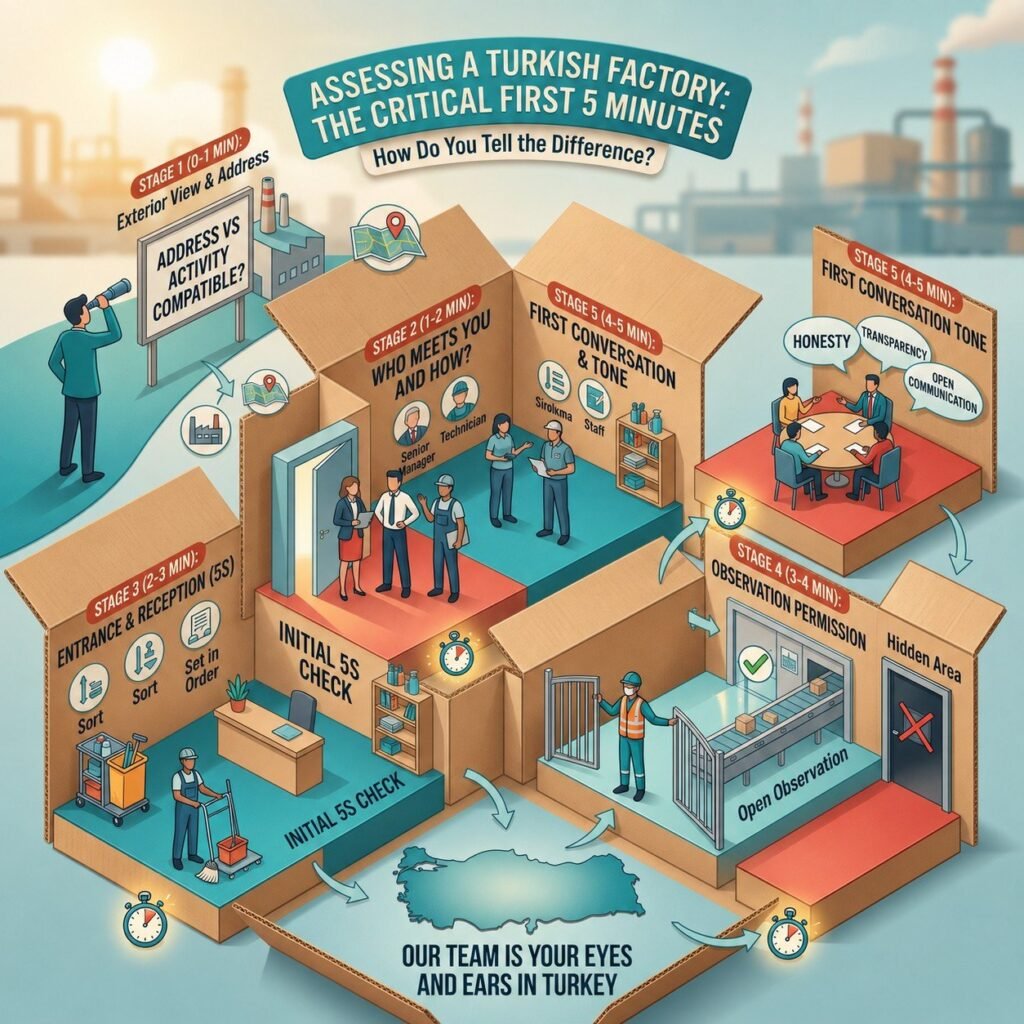
This post answers that question directly. Here is our five-minute framework — the checks our team runs automatically, every time, before the official audit even starts.
1. The Gap Between the Address and the Activity
We start before we even walk through the door. Does the building match the business? A registered manufacturer should occupy an industrial space — visible production activity, loading bays, delivery trucks, the ordinary noise and motion of a working factory.
If the address turns out to be a small office in a commercial building, that is worth noting immediately. It often signals a trading company presenting itself as a manufacturer — a distinction that matters enormously for quality control, pricing transparency, and long-term reliability.
We also check whether the building looks active in proportion to what the supplier claims. A factory claiming 70 employees and three production lines should look and sound like it. Quiet, half-empty premises tell a different story than the one in the sales deck.
2. Who Greets Us — and How
Within the first minute, we already know something important: who is meeting us, and at what level.
Is it the owner? A senior manager? Or a junior staff member who clearly was not expecting visitors? Each of these tells a different story about how seriously the factory takes the relationship.
We also pay attention to whether the welcome feels prepared or improvised. A well-run factory typically has someone ready at the entrance, expecting us, with a clear sense of where we are headed first. A factory caught off guard — confused about who we are or why we are there — raises a small but real flag about internal communication and organisation.
None of this is about formality for its own sake. It is about whether the operation runs with the kind of discipline that will matter later, when a production issue needs fast, clear communication.
3. The State of the Entrance and Reception Area
This is a small detail with outsized predictive value, and it is rooted in a well-established quality discipline called 5S — sort, set in order, shine, standardise, sustain. Factories that practise good housekeeping in their visible, public-facing spaces tend to carry that same discipline onto the production floor.
We look at the obvious things: is the entrance clean? Are safety signs current and visible, not faded or peeling? Is there a visitor sign-in process, and does it look like it gets used regularly rather than dusted off for our visit?
We also glance at the noticeboards, if there are any. Outdated certificates, expired safety notices, or company information that does not match what we were told beforehand are all small inconsistencies worth flagging mentally before we go any further.
4. How Freely We Are Invited to Look Around
This is perhaps the single most telling signal in the entire visit, and it happens almost immediately.
A legitimate, confident manufacturer welcomes scrutiny. They invite us to walk the floor, take photos, and ask questions as we go — without scripting every step of the route. We watch closely for the opposite: hesitation when we ask to see a particular area, a guided tour that feels suspiciously curated, or vague redirection when we ask about a specific production stage.
If access to raw material storage, the warehouse, or any specific production line gets quietly avoided, that is not a scheduling inconvenience. It usually means something is being kept out of view — whether that is outsourced production, substandard conditions, or simply less capability than advertised.
We learned this lesson well during our socks factory visits. Both factories gave us full, unrestricted access from the very first minute. That openness, more than almost anything else, told us we were dealing with confident, legitimate operations.
5. The First Five Minutes of Conversation
Before we discuss a single technical specification, the opening conversation reveals a great deal.
We listen for how the team talks about their own operation. Confident, specific answers — actual numbers, actual processes, actual challenges they have solved — tell us we are speaking with people who genuinely understand their business. Vague, deflecting answers, especially to simple questions like staff numbers or years in operation, tell us something different.
We also listen for how questions get handled when we ask something slightly difficult. A defensive reaction, or a reflexive line like “we can’t share that, it’s proprietary,” is worth noting. Reasonable factories protect genuine trade secrets. They do not use confidentiality as a blanket excuse to avoid basic operational transparency.
This is also where relationship-building genuinely starts to matter, as we covered in our piece on negotiating with Turkish suppliers. The tone set in these first few minutes shapes the entire rest of the visit — and often the entire relationship that follows.
Why the First Five Minutes Matter More Than the Last Five Hours
A factory that knows we are coming has had time to prepare. Floors get swept, machines get serviced, and staff get briefed. That is normal, and it is not necessarily a red flag on its own.
However, the things we cover in this framework are much harder to stage convincingly. You cannot rehearse genuine openness. You cannot manufacture, in five minutes, a culture of organisation that was not already there. The polish that a factory can prepare for a scheduled visit tends to sit on the surface — and the first five minutes are often where that surface starts to show its cracks, or confirm its strength.
This is exactly why our team treats those opening minutes as data, not small talk. By the time we sit down at the table for the formal discussion, we already have a strong directional sense of what we are dealing with.
The Bottom Line
A factory visit does not begin when the meeting starts. It begins the moment we step out of the car. The address, the welcome, the state of the entrance, the freedom we are given to look around, and the tone of the first conversation — together, these set the trajectory for everything that follows.
None of this replaces a full technical audit. It complements it. Our recent visit to two socks factories is a good example of this framework in action — the signals we picked up in the first few minutes lined up closely with what the full audit later confirmed.
For buyers managing supplier relationships from a distance, this is one of the clearest reasons a local, experienced team on the ground makes a measurable difference. Five minutes can tell you almost everything — if you know what to look for.
| Need eyes on the ground in Turkey? Mopcons conducts factory visits and supplier audits across Turkey on behalf of international buyers. We bring this exact framework to every visit — reading the signals that matter before the formal audit even begins. Get in touch to discuss your next sourcing project. |
Frequently Asked Questions
What is 5S in a factory audit context?
5S is a workplace organisation methodology built around five principles: sort, set in order, shine, standardise, and sustain. Factories with strong 5S discipline in their visible, public-facing areas tend to carry the same discipline through to production — making it a useful early indicator during a visit.
Is it normal for a factory to restrict access during a visit?
No. A legitimate manufacturer should welcome full access to production areas, warehouses, and raw material storage. Restricted access to specific areas is one of the clearest warning signs during any factory visit, and it usually warrants direct follow-up questions before moving forward.
How quickly can our team identify a problem during a visit?
Often within the first few minutes. While a full audit takes considerably longer, the opening minutes — building condition, welcome, access, and conversation tone — frequently surface the first genuine signals about how an operation actually runs.
Does a clean, organised facility guarantee good quality?
Not on its own — but it correlates strongly. Industry data shows that factories with poor housekeeping ratings experience significantly higher rates of mixed parts and assembly errors. A clean, organised facility is a strong positive signal, though it should always be paired with a full technical and quality audit.
Need help with sourcing or trade in Turkey?
Talk to a MOPCONS consultant — we handle export, import, sourcing, representation and contracts end to end.
Related Articles
 Business
How to Find and Vet a Business Partner or Agent in Turkey
A step-by-step method for foreign firms to find, vet and safely contract a reliable business partner or agent in Turkey.
Read article → Business
Turkey Free Zones: A Guide for Importers and Exporters
How Turkey's free zones cut customs duties and taxes for importers, exporters and manufacturers, and how to choose the right one.
Read article → Business
Liaison Office vs Subsidiary vs Branch in Turkey: Which to Choose
Liaison office, branch or subsidiary in Turkey? Compare tax, liability and trading rights to pick the right market-entry structure.
Read article →