
We Visited Two Turkish Socks Factories in One Day. Here’s What We Found.
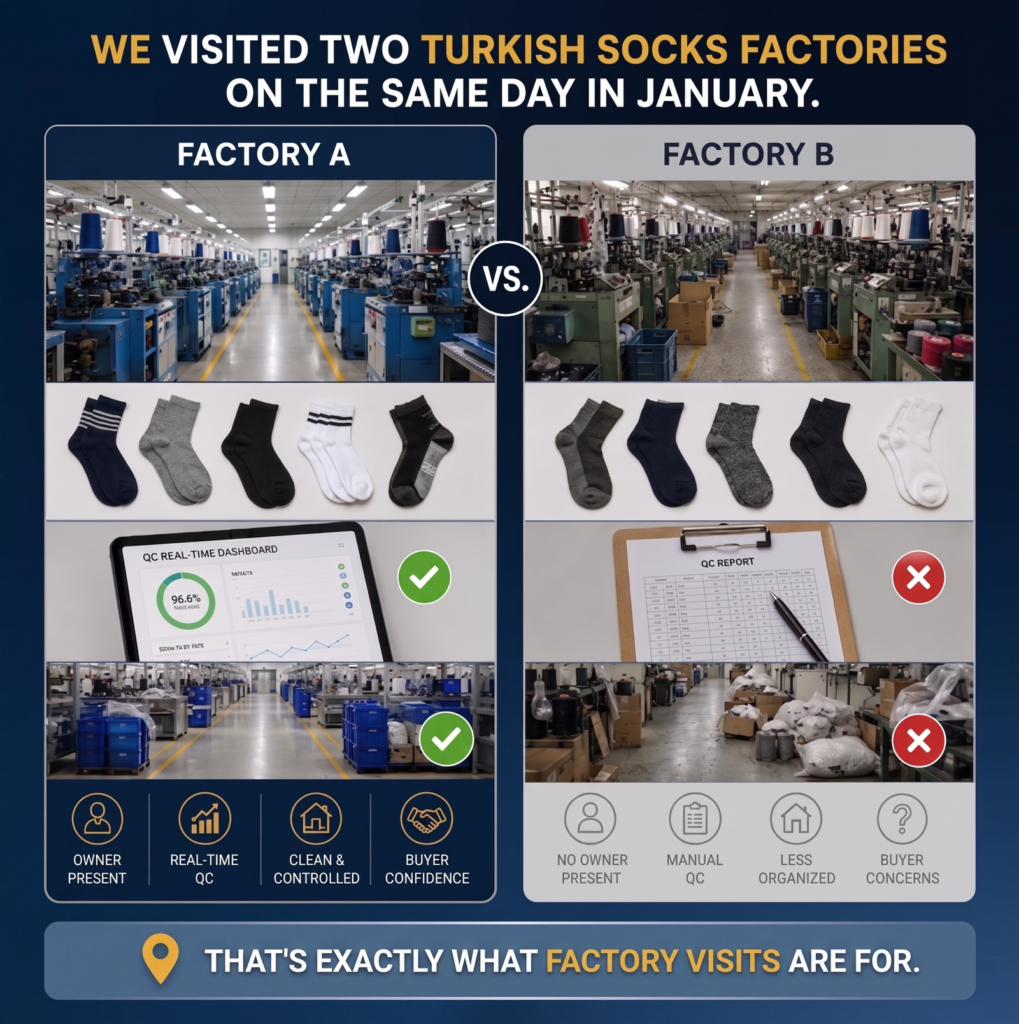
In January 2026, our team spent a full day visiting two socks manufacturers in Turkey — both shortlisted for the same client brief: compression and technical socks for export to European markets. Their websites looked professional, enquiries got fast responses, and samples arrived on time.
On paper, they looked almost identical.
In person, they were not.
This post is a first-hand field report covering what we saw, what the numbers looked like, and — most importantly — what a buyer in London, Amsterdam, or Munich would never have known without our team physically walking those factory floors. To protect confidentiality, we are calling the two factories Factory A and Factory B.
1. The Brief: What We Were Evaluating
Our client needed a Turkish supplier capable of producing compression and technical socks — not basic cotton styles. This distinction matters more than it sounds.
Most Turkish socks factories produce standard cotton socks at high volume. Compression socks, however, require specific machinery, precise needle configurations, and genuine production experience. Not every factory has this capability — even when they claim otherwise.
With that in mind, we evaluated both factories against eight criteria:
- Machine type and technical capability for compression socks
- Annual production capacity and current availability
- Quality control process — both in-line and at final inspection
- Experience with technical socks beyond cotton basics
- Sample-to-bulk consistency
- Packaging capabilities
- General organisation and facility standards
- Management professionalism and communication quality
Both factories completed a pre-screening process based on trade references and sample quality. The factory visits were the final step before our sourcing recommendation. For more on how we structure supplier assessments, see our full guide on supplier auditing in Turkey.
2. Factory A: Strong References, Stronger Floor
Factory A employs around 70 people. It operates both domestic and export sales. Its main export markets are Germany, France, and the UK. At the time of our visit, it produced for several well-known European brands. That kind of reference base tells you a great deal about a factory’s quality consistency and reliability under real commercial pressure.
Machinery and Technical Capability
The factory runs 120 LONATI socks machines in-house. LONATI is the benchmark brand in professional socks manufacturing — Italian-engineered and widely used by serious producers across Europe and Turkey.
Of the 120 machines, 60 are toe closure and 60 are not. This split matters for compression socks, where different construction methods directly affect fit and function.
The machine range covers various needle configurations. This is precisely what makes compression sock production possible. Without the right needle setup, a factory cannot produce the graduated compression profiles that technical socks require. Factory A confirmed this capability during the sample stage — and the factory floor backed it up.
Capacity and Availability
Annual in-house production capacity stands at 12 million pairs. At the time of our visit, the factory was fully loaded. That is a strong signal of commercial health. However, it also means buyers need to plan early and commit clearly to secure production slots.
Current lead time: 6 to 8 weeks.
Quality Control
QC begins at first sampling. Moreover, it runs at every stage of the production line. Final inspection takes place during the packaging stage. All QC processes use AQL inspection sheets — the international standard for acceptable quality levels in textile production.
Sample-to-bulk deflection sits at a maximum of 2-3%. This variance comes primarily from washing machine differences during preshrinking — a standard and well-understood variable in socks manufacturing.
Facility and Management
The production line and warehouse were clean and well-organised. Furthermore, the factory owner was present during our visit — not a junior export manager, but the owner himself. In Turkish manufacturing, this signals that the business takes the relationship seriously. It also means decisions can be made directly, without layers of approval.
| Factory A — Our Assessment Strong production references. Capable machinery. Rigorous QC process. Clean, well-organised facility. Owner present and engaged. Fully loaded at time of visit with 6-8 week lead time. Our recommendation: primary supplier. |
3. Factory B: Export-Focused, With Ambition to Match
Factory B is slightly smaller — around 60 employees. Nevertheless, it runs an intense operation: three shifts, six days a week. It operates on export sales only, with no domestic business.
That distinction is worth paying attention to. A factory that sells exclusively to export markets faces higher and more consistent quality demands than one that also serves domestic customers. It keeps standards sharp.
Main export markets are the same: Germany, France, and the UK. At the time of our visit, Factory B was actively preparing to tender for a German military socks contract. That is a technically demanding category with strict production compliance requirements — another indicator of where this factory’s ambition sits.
Machinery and Technical Capability
Factory B also runs 120 LONATI machines. The split, however, is different: 90 toe closure and 30 non-toe closure. The needle range covers 108 to 200 needles. This gives the factory broad production flexibility across sock styles and compression levels.
Like Factory A, Factory B has real experience with compression and technical socks. In fact, technical socks are their main area of experience — not a secondary capability bolted onto a cotton-basics operation.
Capacity and Availability
Annual in-house production capacity is 10 million pairs — slightly lower than Factory A. At the time of our visit, Factory B was also fully loaded with a 6-8 week lead time.
Quality Control
QC starts at sampling. It then runs hourly throughout the production line. Final inspection happens at the packaging stage. Notably, Factory B offers daily production QC reports to clients. That is a valuable feature for buyers managing production remotely. It removes the guesswork and reduces the anxiety of not knowing what is happening on the floor.
Sample-to-bulk deflection sits at the same 2-3% range — consistent with Factory A and with industry norms.
Facility and Management
General organisation was good. The production line was clean. However, certain areas of the facility could be better organised. It was not a compliance risk, but a buyer with strict facility standards would notice it. The factory owner was present throughout our visit.
| Factory B — Our Assessment Export-only operation with strong technical socks experience. Flexible machinery. Daily QC reporting capability. Fully loaded at time of visit. Our recommendation: backup supplier, with the option to split purchase orders between both factories over time. |
4. Side-by-Side Comparison
| Factor | Factory A | Factory B |
| Employees | ~70 | ~60 |
| Sales Type | Domestic + Export | Export only |
| LONATI Machines | 120 | 120 |
| Toe Closure Split | 60 / 60 | 90 / 30 |
| Needle Range | Various options | 108–200 needles |
| Annual Capacity | 12M pairs | 10M pairs |
| Current Lead Time | 6–8 weeks | 6–8 weeks |
| QC Process | AQL, in-line + final | AQL, hourly + daily client reports |
| Bulk Deflection | Max 2–3% | Max 2–3% |
| Facility Standard | Clean, well-organised | Good — some areas could improve |
| Owner Present | Yes | Yes |
| Our Verdict | Primary supplier | Backup / split PO option |
5. What a Remote Buyer Would Have Missed
This is the section that matters most for any buyer evaluating Turkish suppliers from a distance.
On paper, both factories looked comparable — same LONATI machines, same AQL inspection process, same compression sock experience, and the same European export markets. From an email thread or a trade platform, you would have had almost no basis to choose between them.
On the ground, the picture was clearer.
Factory A’s production floor carried a different energy. It was fully active but controlled. The machines were well-maintained. The QC documentation was in active daily use — not staged for our visit, but genuinely embedded in the operation. The owner’s presence set a tone for the entire meeting.
Factory B impressed in different ways. Its export-only model means the entire operation orients around international standards. The daily QC reporting capability is a genuine differentiator for remote buyers. The German military tender signals exactly what kind of production complexity this team is willing to take on.
The facility observation at Factory B was minor. But it is precisely the kind of detail that only appears in a visit report. It would never show up in a capability deck, a product catalogue, or a supplier questionnaire.
That is exactly what factory visits are for. As a sourcing agent, this is where our value becomes most visible.
6. Our Recommendation
For this client brief, the recommendation was clear. Factory A as the primary supplier. Factory B as a qualified backup — with the option to split purchase orders between both once the relationship develops.
In general, we recommend a dual-supplier approach for most buyers placing significant volumes in Turkey. A single-supplier dependency is a supply chain risk. Having a qualified backup — one already audited, sampled, and assessed — means that a capacity issue, a quality problem, or an unexpected delay does not become a crisis.
Both factories can produce the compression and technical socks required. The difference between them is not capability. It is readiness, track record, and the operational signals that only become visible when our team stands in the room.
| Sourcing socks — or any textile — from Turkey? Mopcons conducts factory visits, supplier audits, and sourcing recommendations across Turkey on behalf of European and global buyers. We visit the factories, assess the floors, read the room, and give you a clear, honest picture of what you are actually buying into. Get in touch to discuss your sourcing brief. |
Frequently Asked Questions
Are Turkish socks factories capable of producing compression socks?
Yes — but not all of them. Compression socks require specific LONATI machines with the right needle configurations. Always verify this during a factory visit or technical audit. A capability statement alone is not enough.
What is a LONATI machine?
LONATI is an Italian manufacturer of professional circular knitting machines for hosiery production. Their machines are the industry standard for quality socks manufacturing worldwide. A factory running LONATI equipment is a strong sign of serious, professional capability.
What does AQL mean in socks manufacturing?
AQL stands for Acceptable Quality Level. It defines the maximum number of defects considered acceptable during a random inspection of a production batch. A factory that uses AQL inspection sheets throughout production has a structured, documented quality process — not informal spot checks.
How do we decide between two qualified Turkish suppliers?
When two suppliers are technically comparable, the decision comes down to track record, production references, facility standards, and management quality. None of these factors are properly visible without a physical visit. A local sourcing partner gives you an honest, unbiased assessment — and helps you make the right call before you commit.
Need help with sourcing or trade in Turkey?
Talk to a MOPCONS consultant — we handle export, import, sourcing, representation and contracts end to end.
Related Articles
 Business
How to Find and Vet a Business Partner or Agent in Turkey
A step-by-step method for foreign firms to find, vet and safely contract a reliable business partner or agent in Turkey.
Read article → Business
Turkey Free Zones: A Guide for Importers and Exporters
How Turkey's free zones cut customs duties and taxes for importers, exporters and manufacturers, and how to choose the right one.
Read article → Business
Liaison Office vs Subsidiary vs Branch in Turkey: Which to Choose
Liaison office, branch or subsidiary in Turkey? Compare tax, liability and trading rights to pick the right market-entry structure.
Read article →